Into This World and Out Again: a Modern Proof of the Origin of Humanity
How modernistic life is transforming the human skeleton
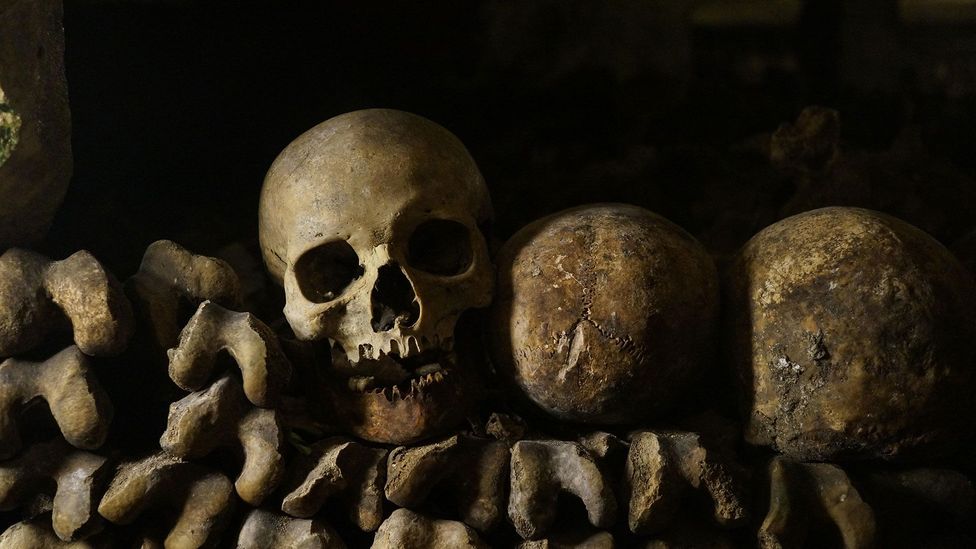
From the emergence of a spiky growth at the dorsum of some people's skulls to the enigmatic finding that our elbows are getting narrower, our bones are changing in surprising ways
I
It all started with a goat. The unfortunate animal was built-in in the Netherlands in the bound of 1939 – and his prospects did not look good. On the left side of his trunk, a bare patch of fur marked the spot where his front leg should have been. On the right, his front leg was so plain-featured, it was more of a stump with a hoof. Walking on all fours was going to be, permit's say, problematic.
Only when he was three months old, the lilliputian goat was adopted by a veterinarian institute and moved to a grassy field. There he quickly improvised his own peculiar style of getting around. Pushing his back feet forrard, he would draw himself up until he was continuing half-upright on his hind legs, and jump. The end result was somewhere between the hop of a kangaroo and a hare, though presumably not quite as majestic.
Sadly the plucky goat was involved in an accident before long after his first birthday, and he died. But there was one last surprise lurking in his skeleton.
For centuries, scientists had thought that our bones were fixed – that they abound in a anticipated way, according to instructions inherited from our parents. Merely when a Dutch anatomist investigated the caprine animal'due south skeleton, they found that he had begun to adapt. The basic in his hips and legs were thicker than yous would wait, while the ones in his ankles had been stretched out. Finally his toes and hips were abnormally angled, to conform a more than upright posture. The caprine animal'south frame had started to look a lot like those of animals which hop.
Y'all might also bask:
• The London landmark with 20,000 skeletons in its vaults
• The basic that could shape Antarctica's fate
• The human who tried to photograph thoughts and dreams
Today it's an established fact that our skeletons are surprisingly malleable. The pure white remains displayed in museums may seem solid and inert, but the bones beneath our flesh are very much live – they're actually pink with claret vessels – and they're constantly existence cleaved down and rebuilt. So although each person's skeleton develops co-ordinate to a rough template set out in their DNA, it is so tailored to accommodate the unique stresses of their life.
This has led to a discipline known as "osteobiography" – literally "the biography of bones" – which involves looking at a skeleton to discover out how its owner lived. Information technology relies on the fact that sure activities, such as walking on ii legs, get out a predictable signature behind, such equally sturdier hip bones.
And from the discovery of a curious spiky growth on the back of many people'south skulls to the realisation that our jaws are getting smaller, to the enigmatic finding that High german youths currently have narrower elbows than always before, it's articulate that modern life is having an touch on our basic.

The Firm of Taga - the famously brawny chief in Tinian (Credit: Getty Images)
For an instance of how osteobiography works, take the mystery of the "strong men" of Guam and the Mariana Islands. It began with the discovery of a male skeleton on the island of Tinian, which lies one,600 miles (2,560km) east of the Philippines in the Pacific Ocean, in 1924. The remains were dated to the 16th or 17th Century, and they were positively gigantic. The man'south skull, arm basic, collarbones, and the bones of his lower legs suggested that he had been immensely strong and unusually tall.
The finding slotted in nicely with local legends of enormous ancient rulers, who had been capable of truly heroic physical feats. Archaeologists called him Taotao Tagga – "man of Tagga" – after the island's famous mythological principal Taga, who was renowned for his super-human strength.
Equally other graves were discovered, it became clear that the first skeleton was no bibelot; in fact as well as fiction, Tinian and the surrounding islands had been habitation to a race of extraordinarily brawny men. Only where had they got their strength from?
As it happens, the potent men's remains were oft found lying side by side to the answer. In the case of Taga, he was buried amongst 12 imposing carved stone pillars, which would originally have supported his house. Meanwhile, a closer inspection of his bones and others has revealed that they accept similar features to those from the Tonga archipelago in the South Pacific, where people do a lot of stone working and building with massive rocks.
The largest such business firm on the island had pillars that were 16ft (5m) loftier and weighed well-nigh 13 tonnes each – about as much as ii full-grown African elephants. This was no mysterious race of muscular giants; the men accomplished their powerful builds by sheer difficult work.
If, in the futurity, the same technique were used to slice together how people lived in 2019, the scientists would find characteristic changes in our skeletons that reflect our modernistic lifestyles.

The time we spend on our smartphones appears to be irresolute the shape of our skulls (Credit: Alamy)
"I have been a clinician for 20 years, and just in the last decade, increasingly I have been discovering that my patients have this growth on the skull," says David Shahar, a health scientist at the University of The Sunshine Declension, Australia.
The spike-like feature, also known as the "external occipital protuberance" is plant at the lower back of the skull, merely in a higher place the neck. If y'all have one, it's likely that you will be able to experience it with your fingers – or if you're baldheaded, it may even be visible from behind.
Until recently, this type of growth was thought to be extremely rare. In 1885, when the spike was first investigated, the renowned French scientist Paul Broca complained that it even had a name at all. "He didn't like information technology because he had studied so many specimens, and he hadn't really seen any which had it."
Feeling that something might be up, Shahar decided to investigate. Together with his colleague, he analysed over a one thousand X-rays of skulls from people ranging from 18 to 86 years erstwhile. They measured whatever spikes and noted what each participant's posture was like.*
What the scientists institute was striking. The fasten was far more prevalent than they had expected, and also a lot more than common in the youngest age group: 1 in four people aged 18-30 had the growth. Why could this be? And should nosotros be concerned?
Shahar thinks the spike explosion is downwardly to modern technology, specially our recent obsession with smartphones and tablets. Every bit we hunch over them, we crane our necks and concur our heads frontwards. This is problematic, because the average caput weighs effectually 10 pounds (4.5 kg) – about every bit much as a large watermelon.
Text neck
When we're sitting upright, these hefty objects are balanced neatly on tiptop of our spines. Simply as we lean forwards to pore over famous dogs on social media, our necks must strain to hold them in place. Doctors telephone call the pain this can crusade "text cervix". Shahar thinks the spikes course because the hunched posture creates extra pressure on the place where the cervix muscles attach to the skull – and the torso responds by laying down fresh layers of bone. These help the skull to cope with the actress stress, by spreading the weight over a wider area.
Of course, bad posture was non invented in the 21st Century – people have always plant something to hunch over. So why didn't we go the skull protuberances from books? One possibility is downward to the sheer amount of time that we currently spend on our phones, versus how long a person would previously have spent reading. For case, even in 1973, well before most modern mitt-held distractions were invented, the boilerplate American typically read for near ii hours each day. In dissimilarity, today people are spending nearly double that fourth dimension on their phones.
Indeed, for Shahar, the biggest surprise was just how large the spikes were. Before his study, the most recent research was conducted at an osteological lab in India, in 2012. That's a lab specialising entirely in bones – equally you can imagine, they accept quite a lot of skulls – but the doctor there just found one with the growth. It measured 8 mm, which is so small, it wouldn't even have been included in Shahar's results. "And he idea it was pregnant enough to write a whole paper about it!" he says. In his ain study, the near substantial growths were 30mm long.
Intriguingly, the potent men from the Mariana islands besides tend to accept growths on their skulls. They are thought to have developed for a similar reason – to back up their powerful cervix and shoulder muscles. The men may accept carried heavy weights past suspending them from poles across their shoulders.
Shahar says it's likely that the modern spikes will never go away. They will proceed to get bigger and bigger – "Imagine if yous take stalactites and stalagmites, if no 1 is bothering them, they will but keep growing" – but it's rare for them to cause whatever trouble by themselves. If there is an outcome, it will probably be caused by the other compensations that the body must make for all our hunching.
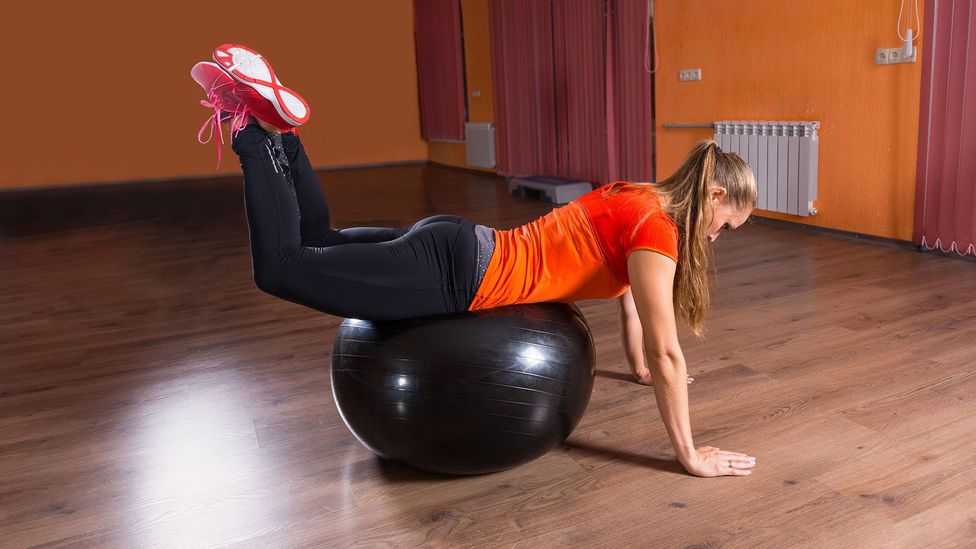
Our elbows seem to exist shrinking, perchance because we take less practice than past generations (Credit: Alamy)
On the other side of the world, in Federal republic of germany, scientists accept discovered another baroque evolution: our elbows are shrinking. Christiane Scheffler, an anthropologist from the University of Potsdam, was studying body measurements taken from school children when she noticed the tendency.
To meet exactly how much their skeletons had inverse over time, Scheffler undertook a study of how robust, or "big boned", children were between 1999 and 2009. This involved calculating their "frame index", which is how a person'south top compares to the width of their elbows. Then she compared her results with those from an identical report that was 10 years older. She found that the children'south skeletons were condign more and more fragile every year.
"And and then we were thinking about that, what could be the reason," says Scheffler. Her first thought was that information technology could be genetic, just it's hard to see how a population'due south Deoxyribonucleic acid could change that much in just ten years. The second was that mayhap the children were suffering from poor diet, just this isn't really a problem in Germany. The third was that today's youth are a generation of couch potatoes.
To observe out, Scheffler conducted a new written report – together with some colleagues this time – in which she likewise asked the children to fill out a questionnaire most their daily habits, and to clothing a step counter for a week. The team found a strong link betwixt how robust the children's skeletons were and the corporeality of walking they were doing.
It'southward already well known that every time we use our muscles, we help to increment the mass of the bones that support them. "If you use them again and over again, they build more than os tissue, which is measured equally a higher density and bigger girth of os," says Scheffler. The children'south shrinking skeletons look like a straightforward adaptation to modern life, since it doesn't brand sense to grow os that you don't need.
But at that place was one surprise lurking in the data: walking was the but type of exercise that seemed to have any impact. Scheffler thinks this is because even the virtually avid sports fans actually devote very little fourth dimension to practising. "It'southward not helpful if your mother takes you in the car for one or 2 hours per week," she says.
And though no 1 has looked at whether the link holds up in adults, information technology's likely that the same rules apply: it's not enough to but hit the gym a couple of times a week without too walking long distances. "Because our development tells us that we can walk for almost 30km (19 miles) per solar day."
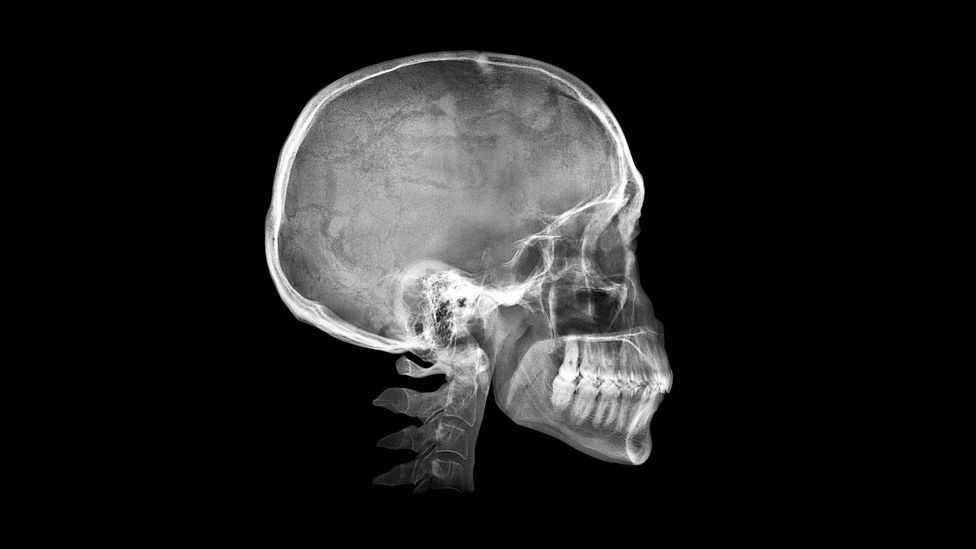
The slight overbite of modernistic humans has shaped the mode we speak - easing the production of "f" and "v" sounds (Credit: Alamy)
The final surprise subconscious in our basic may have been happening for hundreds of years, but we've just just noticed. Back in 2011, Noreen von Cramon-Taubadel from The State Academy of New York at Buffalo, was studying skulls. As an anthropologist, she was keen to find out to if it was possible to tell where one was from, only by looking at its shape.
In her quest for an answer, Cramon-Taubadel had been scouring the collections of museums from all over the earth for skulls to compare, and painstakingly measuring them. It was indeed the example that, on the whole, you could tell roughly where a skull was from, and who its possessor was related to, just from its shape. Just there was one role where this wasn't the case: the jaw.
It shortly became clear that instead of being determined by genetics, the shape of the jaw was mostly afflicted by whether that person had grown upwardly in a hunter-gatherer society, or a customs that relied on farming. Cramon-Taubadel thinks it'south all down to how much chewing we practise as we're growing up. "If yous think virtually orthodontics, obviously the reason we practise that with teenagers is because their bones are nevertheless growing," says Cramon-Taubadel. "Bones are nonetheless malleable at that age and they will reply to unlike pressures."
In modern, farming-based societies where the nutrient is soft and palatable, nosotros can wolf down a meal without needing to mash it up much first. Less chewing makes for weaker muscles, which means our jaws don't develop as robustly. Another idea is that information technology's downwards to breastfeeding, because the age at which mothers wean their children varies widely, and dictates when they begin chewing more solid food.
But there's no need to mourn your weak farmer's jawline just yet. Cramon-Taubadel says the impact chewing tin have on the lower face is really adequately subtle to the naked eye. Instead, it'southward likely to bear witness in our teeth. "So the principal trouble is that especially in post-industrial populations, we're much more probable to suffer from dental problems – dental crowding, crooked teeth, etc.," she says. "Right at present, what the research is showing is that having a slightly more biomechanically tough diet, peculiarly in children, might be useful for counteracting some of the imbalance between the fashion that our teeth grow and develop and push through.".
And here there'due south an unexpected twist. Incredibly, information technology now seems that the changes to our jaws and teeth have had ane welcome side issue at least – on the way that we speak. A recent report found that, as societies discovered agriculture in the Neolithic menstruation, roughly 12,000 years ago, the changes to our bites may take immune u.s.a. to pronounce new sounds, such as "f" and "v". The researchers estimated that this transformed the languages that people spoke, from containing only 3% of these difficult sounds to 76% today.
Rather than having bites, like we do at present, where the upper incisors (upper front teeth) covered the lower ones, previously adults would take had bites where they met instead. To catapult your jaw dorsum to Neolithic times, try pushing out your lower jaw until your upper and lower teeth touch, and so try to say "fish" or "Venice".
So what will hereafter archaeologists make of our skeletons, when they examine them from their spaceships? If we're not careful, they'll reveal unhealthy diets, staggering levels of inactivity, and a morbid zipper to technology. Perhaps it'southward best to be cremated.
--
[*Editor'south annotation: Since this article was published, some questions have been raised most the methodology of the Scientific Reports paper examining the "external occipital protuberance". For more information, see PBS NewsHour'south in-depth assay.]
Join more than one meg Hereafter fans past liking united states of america on Facebook , or follow united states on Twitter or Instagram .
If you liked this story, sign up for the weekly bbc.com features newsletter , called "If You Only Read vi Things This Week". A handpicked selection of stories from BBC Future, Civilisation, Capital, and Travel, delivered to your inbox every Friday.
Source: https://www.bbc.com/future/article/20190610-how-modern-life-is-transforming-the-human-skeleton
0 Response to "Into This World and Out Again: a Modern Proof of the Origin of Humanity"
Post a Comment